
Target with Four Faces, 1979
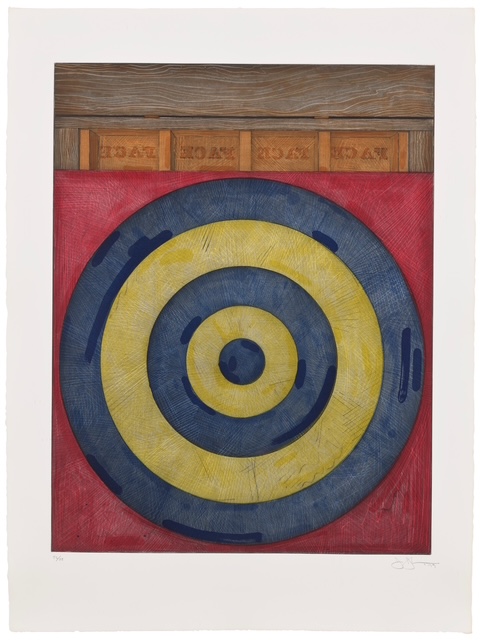
Hand-signed in pencil, dated, and numbered
From an edition of 88
30 x 22 1/2 inches (76.3 x 56.6 cm.)
All works are inspected prior to delivery, work will be sent out tracked and insured at buyers cost. If you'd like to make specific arrangements or discuss collection then please contact us directly.
Accepted: Wire transfer
ART PLEASE Assurance Policy: Every ART PLEASE seller has been approved by ART PLEASE after a thorough review. All of our sellers are required to accept the following ART PLEASE policy: A buyer may return an item purchased through ART PLEASE, if the item received is not as described in its listing, or is found to be unauthentic.
Jasper Johns is one of the most influential American artists of the postwar era, whose work helped reshape the course of contemporary art by bridging Abstract Expressionism with the emergence of Pop Art, Minimalism, and Conceptual Art. Beginning in the 1950s, Johns turned away from purely gestural abstraction and instead focused on familiar, instantly recognizable images—including flags, targets, numbers, maps, and letters. By presenting symbols that viewers already “know,” Johns shifted attention away from what an image depicts and toward how it is constructed, perceived, and interpreted. His rigorous experimentation extended throughout his celebrated printmaking practice, where etching, lithography, and other techniques allowed him to continually reconsider many of the central images of his career.
*Target with Four Faces*, 1979, revisits one of Johns’s most iconic subjects, the target, a motif he first introduced in the mid-1950s and repeatedly explored across painting, sculpture, and printmaking. Here, concentric rings of blue and yellow appear against a red field, while four compartments positioned above the target contain the reversed word “FACE”—a graphic reference to the sculpted faces that appeared in Johns’s seminal 1955 *Target with Four Faces*. The combination creates a characteristic tension between something immediately recognizable and something deliberately ambiguous: a target normally directs the eye toward a precise point, while the fragmented suggestion of the human face complicates the act of looking itself. Executed as a color intaglio on Rives paper, the work was printed by Atelier Crommelynck and published by Petersburg Press in an edition of 88, with additional artist’s proofs. Measuring approximately 30 × 22 ½ inches (76.3 × 56.6 cm), it is hand-signed, dated, and numbered in pencil and is recorded in the catalogue raisonné as ULAE 203.