
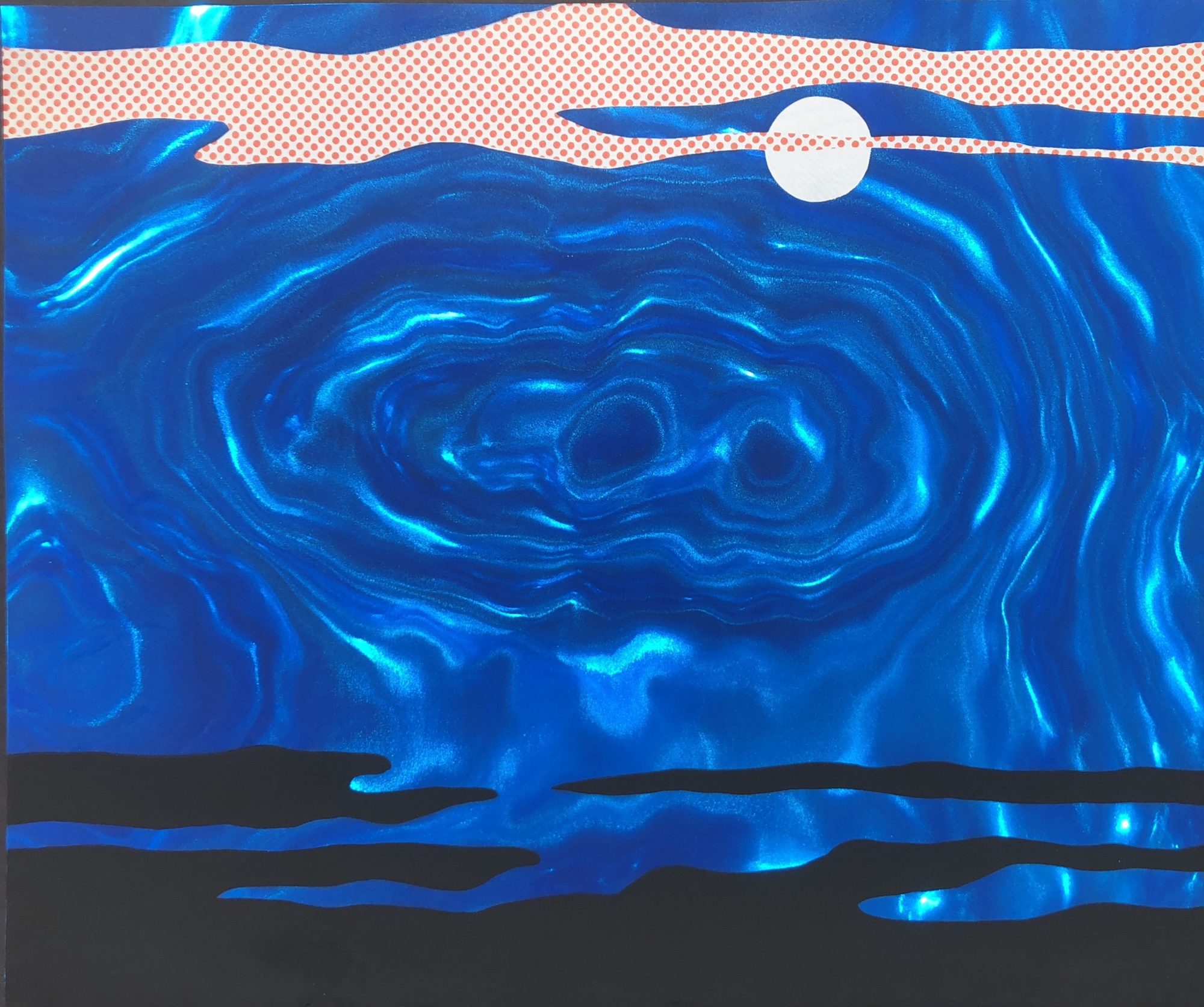
Moonscape (from the 11 Pop Artists portfolio, Volume I), 1965
Signed, dated and numbered from an edition of 200
20 × 24 inches (50.8 × 61 cm.)
All works are inspected prior to delivery, work will be sent out tracked and insured at buyers cost. If you'd like to make specific arrangements or discuss collection then please contact us directly.
Accepted: Wire transfer
ART PLEASE Assurance Policy: Every ART PLEASE seller has been approved by ART PLEASE after a thorough review. All of our sellers are required to accept the following ART PLEASE policy: A buyer may return an item purchased through ART PLEASE, if the item received is not as described in its listing, or is found to be unauthentic.
Roy Lichtenstein (1923–1997) was one of the leading figures of American Pop Art, best known for transforming the visual language of comic strips and commercial printing into large-scale, ironic paintings and prints. Drawing on Ben-Day dots, bold outlines, and flat primary colors, he mimicked and exaggerated the look of cheap mechanical reproduction to question what counts as “high” art. In the early to mid-1960s, Lichtenstein applied this vocabulary not only to romance and war comics but also to landscapes and seascapes, often reducing natural scenes to a few crisp, graphic elements. Printmaking was central to his practice, giving him a direct way to engage with the mass-production processes he was parodying and elevating.
Moonscape (from the 11 Pop Artists portfolio, Volume I), 1965, is a screenprint in colors on blue Rowlux—an industrial, lenticular-like plastic that shimmers and appears to shift as the viewer moves. Signed, dated, and numbered from an edition of 200, the work measures 20 × 24 inches (50.8 × 61 cm). Against the subtly moving blue ground, Lichtenstein arranges a simplified, cartoon-like lunar horizon in bold white and black, turning the idea of a moon landscape into a sleek, almost abstract graphic. The use of Rowlux is crucial: it heightens the sense of artificiality while also suggesting the flicker of light across a distant, otherworldly surface. In this way, Moonscape captures Lichtenstein’s Pop strategy perfectly—an image of outer space rendered through the visual clichés and synthetic materials of mid-century consumer culture.