
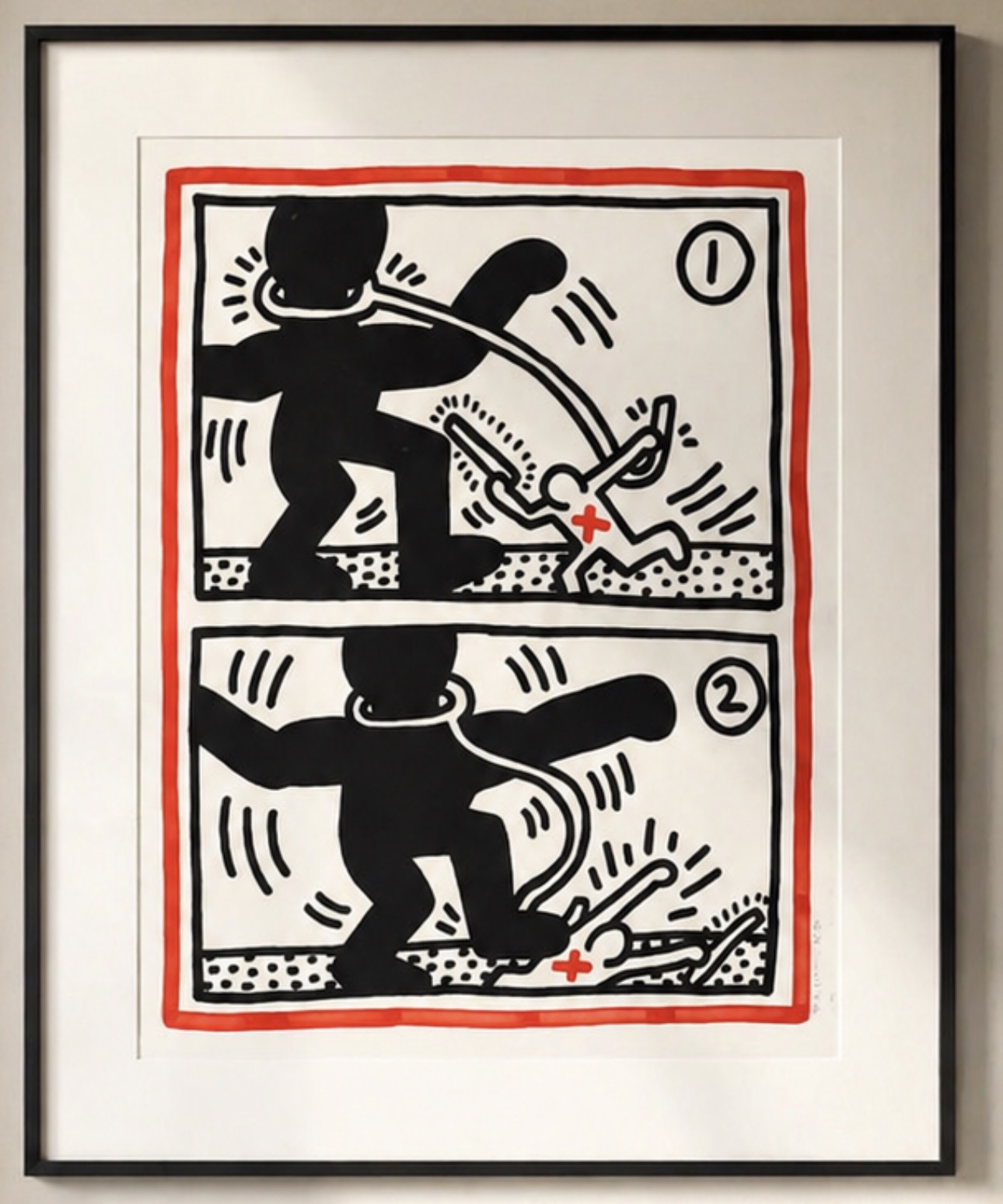
Free South Africa, 1985
From an edition of 60
Signed and numbered
40 × 31 9/10 inches (101.5 × 81 cm.)
All works are inspected prior to delivery, work will be sent out tracked and insured at buyers cost. If you'd like to make specific arrangements or discuss collection then please contact us directly.
Accepted: Wire transfer
ART PLEASE Assurance Policy: Every ART PLEASE seller has been approved by ART PLEASE after a thorough review. All of our sellers are required to accept the following ART PLEASE policy: A buyer may return an item purchased through ART PLEASE, if the item received is not as described in its listing, or is found to be unauthentic.
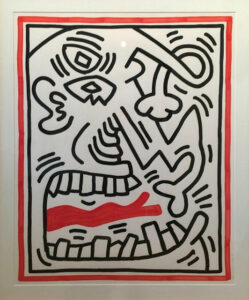
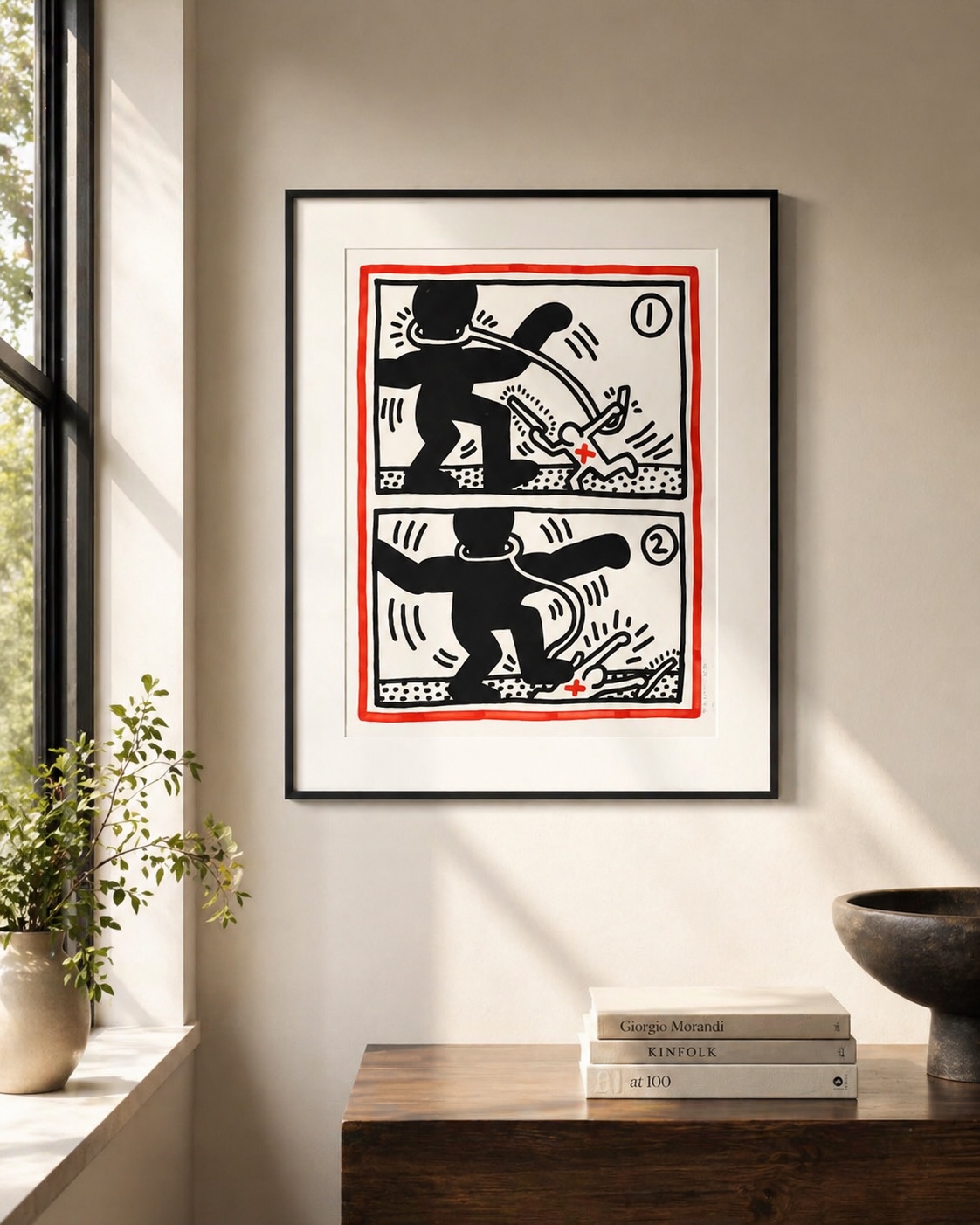
Keith Haring’s Free South Africa is one of his most direct and politically charged works, reflecting his deep engagement with global social justice movements during the 1980s. Created as a lithograph in an edition of 60, and signed and numbered by the artist, the work exemplifies Haring’s ability to distill complex political realities into a stark, universally legible visual language. Measuring 40 × 31 9/10 inches (101.5 × 81 cm.), the composition unfolds in two comic-like panels framed by a bold red border. The imagery is immediate and forceful: a large black figure dominates and subjugates a smaller white figure, reversing expected visual hierarchies and confronting the viewer with the brutality and imbalance inherent in apartheid-era South Africa. The red accents heighten the sense of urgency and violence, while the simplified forms ensure the message is accessible across cultural and linguistic boundaries.
Haring’s work was never detached from the world around him, and Free South Africa stands as a powerful example of art as activism. At a time when international awareness and pressure against apartheid were building, Haring used his platform to amplify the call for liberation and equality. The rhythmic lines and kinetic energy—hallmarks of his style—imbue the scene with movement, but also tension, emphasizing both struggle and resistance. By employing a visual vocabulary rooted in street art and public space, Haring ensured that his message resonated beyond traditional art audiences, aligning his practice with protest and solidarity. Today, the work remains not only a compelling piece of graphic art but also a historical document of artistic resistance, underscoring Haring’s belief that art can—and should—be a vehicle for social change.